Indian Space agency Indian Space Research Organisation would launch the Geo-synchronous Satellite Launch Vehicle-Mark III (LVM3 X mission) on December 18 which would carry active solid boosters, liquid core stage and a passive cryo-stage.

The rocket is almost 49 meters high -- as much as a 17-floor building. It weighs 415 tons -- as much as the combined weight of 80 full grown elephants.

India will become the fourth country to master the technology of soft-landing on the lunar surface after the US, China and the erstwhile Soviet Union.

After having successfully completed three orbit raising manoeuvres, ISRO's Mars Orbiter mission on Monday suffered a glitch as it failed to achieve the targeted apogee (farthest distance from Earth) of one lakh km during the fourth orbit raising operation in the early hours.

ISRO Chairman K Sivan described the GSAT-11 as the "richest space asset" for India.

If the April launch of the Chandrayaan-2, the country's second mission to the Moon, is not possible, then the ISRO will aim for a launch by October.
Mainstream American newspapers, many of which had been sceptical of India's space mission and sometimes even made fun of it through cartoons, noted the great Indian achievement.
'When you look at it from the point of view of science, Chandrayaan 2 is a big success.'

'You declare a date, time and place for the landing two months in advance and exactly at that moment, it touched on the moon.'
'Perhaps the government should explain how the same scientific temper, which authored a precise landing for Chandrayaan-3, finds the periodic table and the theory of evolution not good enough for inclusion in the educational curriculum,' asserts Shyam G Menon.

"It is going to be the most complex mission ever undertaken by ISRO. It is going to take place between July 9 and 16, this year," Sivan said, addressing scientists from the Mission Control Centre.

India created history on Wednesday when the lander module of Chandrayaan-3 touched down on the lunar south pole, propelling the country to an exclusive club of four and making it the first country to land on the uncharted surface.
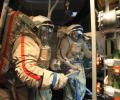
Four Indian Air Force fighter pilots are currently under training in Moscow, and are likely to be potential candidates for the Gaganyaan project.

'Today onwards, the onboard thrusters will be fired and Chandryaan-3 will be taken away from Earth for an eventful landing on Moon's surface on August 23'

"Since its injection into Earth's orbit yesterday, it has been functioning smoothly on the orbit. We are planning to perform orbit raising manoeuvres in the early hours of of Thursday," an Indian Space Research Organisation spokesman told PTI over phone.

In the first dedicated mission of its commercial arm New Space India Limited (NSIL), the Indian Space Research Organisation on Sunday successfully launched Brazil's earth observation satellite Amazonia-1 and 18 other co-passengers, including five built by students, onboard a Polar rocket from the spaceport in Sriharikota.
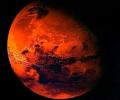
Crossing a major milestone in the country's space history, ISRO's Mars Orbiter mission ventured out of Earth's sphere of influence for the first time in an attempt to reach the red planet's orbit

Out of its 47 operational satellites, India currently has six to eight satellites which are used entirely for military purposes.

According to the space agency, Chandra's Surface Thermophysical Experiment measured the temperature profile of the lunar topsoil around the south pole, to understand the thermal behaviour of the Moon's surface.

Preparations are in the final stages by the Chennai-headquartered space-tech startup Agnikul Cosmos for the maiden launch of India's first-ever private launchpad and the second rocket launch by a private sector player.

India's first unmanned spacecraft Chandrayaan-1 entered the lunar orbit on Saturday after Indian Space Research Organisation scientists successfully carried out a highly complex and tricky manoeuvre crossing another historic milestone in the country's space programme.

The Indian Space Research Organisation successfully launched India's fifth navigation satellite IRNSS-1E from Sriharikota.
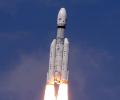
'ISRO takes a very cautious approach.' 'After reaching the moon, the orbit has to be brought down from a single elliptical orbit to a circular orbit while simultaneously ensuring the stability of Chandrayaan 3 and the health parameters of the lander and rover.'

PSLV C-29 blasted off from the Satish Dhawan Space Centre, about 110 km from Chennai, at 6 pm and released the six satellites one by one into a 550 km circular orbit.

Indian Space Research Organisation will announce a revised launch date later.
India's ambitious attempt to flight-test its indigenous cryogenic engine on Thursday received a setback as the homegrown rocket Geosynchronous Satellite Launch Vehicle (GSLV-D3) deviated from path within seconds of lift-off.

Glimpses of what the historic Chandrayaan Mission discovered on the dark side of the Moon.
Chandrayan's operations will be controlled by robots and cover 3.50 lakh kilometre within a period of two years, ISRO chairman G Madhavan Nair said.
Chief of the Indian Space Research Organisation K Radhakrishnan, while commenting on the failure of the latest communication satellite GSAT-5P onboard homegrown GSLV-F06 powered by a Russian cryogenic engine, said that the vehicle faced problems 50 seconds after its launch."The command for aborting the launch was issued when the vehicle was at an altitude of 8 km and 2.5 km away from Sriharikota," said the ISRO chief.
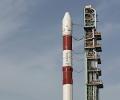
ISRO said, initially the launch was slated for 9.49 am, but now there is a 3-minute delay owing to the probability of space debris in the path of rocket.

'ISRO provides a very positive atmosphere. What matters here is your talent, not your gender,' says Ritu Karidhal, Deputy Operations Director, India's Mars orbital mission, Mangalyaan. A fascinating excerpt from Minnie Vaid's Those Magnificent Women And Their Flying Machines, Isro's Mission To Mars.

They made history for India and the world.

GSAT-18, which aims at providing telecommunications services for the country by strengthening ISRO's current fleet of 14 operational telecom satellites, was launched into a Geosynchronous Transfer Orbit about 32 minutes after the lift-off.
All progress in space should excite us and encourage us to be optimists about a better future for our planet and all of us, asserts Aakar Patel.

From The New York Times to BBC and The Guardian to The Washington Post, the historic event in India's space programme on Wednesday made headlines across the globe.

Amphibious drones for maritime inspection... devices that extract pure oxygen from water for patients in need... self-balancing electric bikes...

Two de-orbit manoeuvres of Vikram Lander, to bring it further down, have been planned to prepare for its landing in the south polar region of the moon.

Swapnila said they saw the GSLV Mk-III rocket that will launch the mission into space. "It was so huge," she added.

Just over 22 minutes into the flight, the rocket put Astrosat into orbit at an altitude of 650 km above the earth
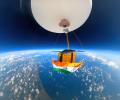
Lauding India's ambitious space programme, The New York Times has said the country, currently witnessing an 'explosive' growth in space-tech start-ups, is set to 'transform the planet's connection to the final frontier' and can emerge as a 'counterweight' to China.
